Alejandro Páez
Sysadmin & ISP Network Specialist
14+ years operating ISP backbone. Cut overnight incidents by 80% with automation, real-time observability, and AI applied to technical work.
- Proxmox cluster, 7+ nodes
- 50+ VMs in production
- Real-time alerts (Zabbix + Telegram)
Problems I solve
Critical ISP infrastructure, Linux systems, and automation so core services run 24/7 with no surprises.
Stable ISP networks
BGP, routing, VLANs, VPNs, WISP, FTTH/ADSL, and redundancy/load balancing for 24/7 services.
Operable virtualization
Proxmox cluster with 7+ nodes, 50+ VMs in production, and hot backups with PBS.
Actionable observability
Zabbix, Grafana, Nagios, and Telegram bot alerts to reduce overnight incidents.
Corporate services
Email with Postfix/Dovecot, DKIM/SPF/DMARC, VoIP with Asterisk/Issabel, and internal collaboration.
AI applied to technical operations
Codex, Claude, OpenCode, Gemini, and Ollama for troubleshooting, documentation, automation, and change review.
Featured case studies
Real ISP implementations, focused on operational stability, automation, and measurable results.
RPO 1 h · RTO 30-60 minProxmox cluster + PBS
- Problem: scaling production and development environments with operational continuity.
- What I did: deployed a Proxmox cluster with 7+ nodes across production and development.

- Result: automated hot backups with Proxmox Backup Server.
- Proxmox VE
- Proxmox Backup Server
View details2 IPT · 5 CDNs · 2 peeringsBGP peering and ISP routing
- Problem: growth of a topology with upstreams, CDNs, and traffic delivered to third parties.
- What I did: operated multi-homed BGP with routing policies, RPKI/IRR filters, and CDN prioritization.
- Result: 2 IPT upstreams, 2 external CDNs, 3 local CDNs, and 2 peerings to external customers.
View detailsMTTR 90 min to 30 minReal-time observability and alerting
- Problem: low visibility and late alerts on critical routers and servers.
- What I did: deployed Zabbix + Nagios + Grafana with alerts via Telegram bot.
- Result: real-time alerting for core infrastructure and services.
- Zabbix
- Nagios
- Grafana
- Telegram Bot
View details50-60 VMs · 99.5%-99.9% uptimeManaging 50+ VMs in production
- Problem: running open source services in production at scale.
- What I did: deployed and managed more than 50 VMs for critical services.
- Result: sustained operation of email, VoIP, monitoring, collaboration, and internal management.
View details Professional Experience
About me
I have been designing and operating critical infrastructure for ISPs for more than 14 years. My stack covers BGP, ISP routing, Proxmox (7+ node cluster), Zabbix/Grafana, corporate email, and VoIP. I combine network architecture, Linux systems, automation, and applied AI so services run 24/7 with no surprises.
- Critical infrastructure: BGP, routing, IPv4, and high availability for 24/7 services.
- Virtualization at scale: Proxmox cluster with 7+ nodes, 50+ VMs in production, and hot backups with PBS.
- Real-time observability: Zabbix + Grafana with Telegram bot alerts.
- Applied AI: code agents, local LLMs, and assisted review to speed up diagnosis, documentation, and technical delivery.
I drive the ISP's digital transformation through automation, collaboration (Nextcloud, Kanboard), and corporate services such as email (Postfix/Dovecot with DKIM/SPF/DMARC) and VoIP (Asterisk/Issabel).
- Networking: design and operation of BGP peers (policies and filters), static/dynamic routing, VLANs, VPNs (IPSec/L2TP/OpenVPN/WireGuard), WISP links, and FTTH/ADSL access; redundancy/load balancing and operational continuity.
- Systems: physical/virtual servers with Proxmox (cluster and PBS), Linux (Ubuntu/Debian/CentOS), Nginx/Apache, Docker Compose, and script-based automation.
- Observability & Security: Nagios, Zabbix, Grafana, FreeRADIUS, hardening, traffic monitoring (carriers/users), Let’s Encrypt, cybersecurity best practices.
- Management & Leadership: L2/L3 support, team training, cross-area coordination (network, NOC, field, support), datacenter services (VMs/housing), and procurement of routers/OLTs/ONTs.
- Applied AI: Codex, Claude, OpenCode, Gemini, Ollama/Open WebUI, practical prompt engineering, and Git-assisted review.
Technology and Innovation Supervisor — Ecolan Internet - Soluciones Tecnológicas
February 2024 — Present
- Standardized observability with Zabbix + Grafana and Telegram bot alerts, reducing overnight incidents by 80%.
- Automated operational processes and consolidated corporate services (email and VoIP) with 24/7 continuity.
- Defined continuity and scalability practices backed by hot backups with PBS (RPO 1 h · RTO 30-60 min).
Technical Support and Customer Service Coordinator — Ecolan Internet - Soluciones Tecnológicas
June 2020 — January 2024
- Coordinated L2/L3 support and the handoff with NOC and field teams, cutting core-incident MTTR from 90 to 30 minutes.
- Managed incidents on passive on-call duty, sustaining 99.5%-99.9% uptime for critical services.
- Trained the team and improved support processes to escalate and document cases consistently.
HelpDesk L1/L2/L3 — Ecolan Internet - Soluciones Tecnológicas
July 2011 — December 2023
- Resolved connectivity and service incidents at L1, L2, and L3 across more than 12 years of ISP operations.
- Maintained network and systems infrastructure in 24/7 high-availability environments.
- Escalated and documented critical cases, building the foundation of the team's reusable runbooks.
Skills
Collaboration & Management
AI applied to networks, systems, and automation
I use generative AI, code agents, and local models as technical copilots to speed up diagnosis, documentation, automation, and change review in infrastructure environments. I work with scoped context, protected data, local validation, Git diffs, and human review before applying changes.
01Context
Repo, goal, constraints, sensitive data, and limits on what must not leave.
02Plan
Hypothesis, scope, affected files, validation criteria, and rollback.
03Execution
The right agent or model for the risk: cloud, local, CLI, or manual review.
04Wrap-up
Reviewed diff, tests, documentation, traceable commit, and reusable learning.
Operational impact
- Faster initial diagnosis of recurring incidents through assisted analysis of logs, metrics, and runbooks.
- More consistent operational documentation for infrastructure procedures.
- Lower risk in production changes by requiring diffs, local validation, and human review.
- Better signal classification before alerting or blocking, reducing false positives.
Infrastructure diagnosis
Assisted analysis of logs, metrics, errors, configurations, and runbooks to reach a verifiable technical hypothesis sooner.
Per-repo code agents
I use Codex, Claude, OpenCode, and Gemini with per-project rules to implement small changes, review diffs, and uphold technical standards.
Local LLMs and sensitive data
I use Ollama and Open WebUI for workflows where operational context should stay within my own infrastructure.
Automation and scripts
I speed up CLI tools, parsers, API integrations, operations scripts, and executable documentation without giving up human review.
Operational security
I use LLMs as a support layer to classify context, explain signals, and reduce false positives; never as the sole blocking authority.
Quality, control, and traceability
Every assisted change ends with human review, lint, build, tests when applicable, Git diff, documentation, and a traceable commit.
Evidence in projects
- CentinelaLocal Ollama inside the threat intel pipeline to classify context and reduce false positives before alerting or blocking.
- Infra docs / runbooksOllama/Open WebUI procedures and Elastic/Proxmox log analysis with a local model and operational output.
- PortfolioNext.js, CONTENT/AGENTS rules, anonymized screenshots, local validation, and a Codex-assisted commit workflow.
- Per-repo rulesAGENTS.md, CLAUDE.md, RTK.md, and project-specific prompts to give code agents stable context.
- Dashboards and CLIsAssisted review for Python/JavaScript tools with APIs, caching, reports, local dashboards, and operations workflows.
Controls I apply
- Never publish secrets, credentials, or raw production data.
- Use a local LLM when operational context must not leave.
- Work with scope limited to a repo, file, or task.
- Validate with lint, build, tests, or a reproducible manual check.
- Review the Git diff before accepting changes.
- Document decisions, evidence, and rollback when applicable.
Principle: AI proposes, the operator validates.
Projects
Tools, automations, and dashboards built for real operations.
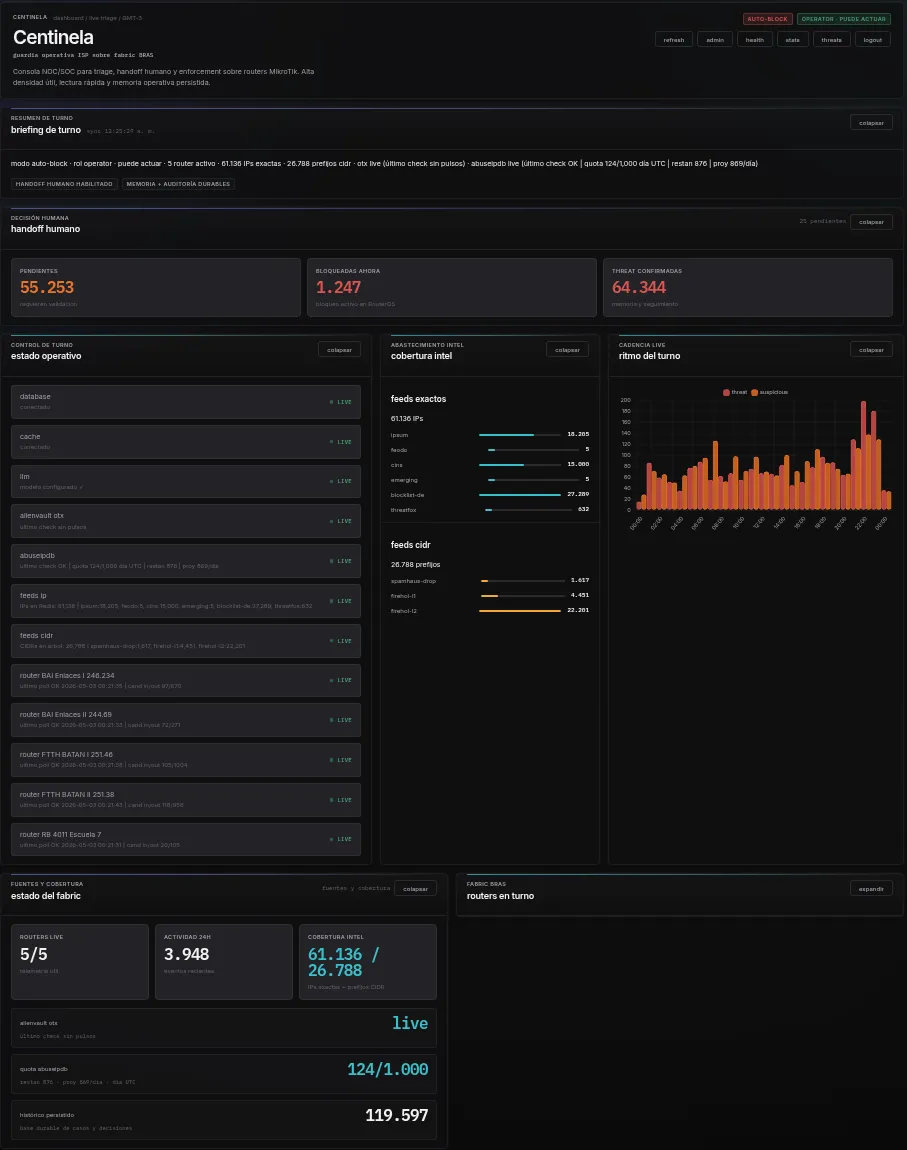
Real-time automatic detection and blocking of network threats for ISPs. Monitors MikroTik router connections via API and blocks malicious IPs with multi-layer threat intelligence.
- MikroTik API
- AbuseIPDB
- Ollama
- GeoIP
Private repositoryLocal dashboard to track Argentine Central Bank (BCRA) indicators from a single screen. Combines a Python HTTP proxy, local cache with stale fallback, and a static frontend with no external dependencies.
- HTTP proxy
- Stale cache
- Static frontend
- BCRA API
View repositoryCycling data analysis dashboard. Imports, consolidates, and visualizes training sessions with decoupled ingestion, DuckDB storage, and interactive charts with Dash + Plotly.
View repositoryCLI toolkit to review, create, and monitor Meta Ads campaigns. Validates Marketing API access, lists campaigns, creates variants, and spins up a local metrics dashboard.
- Meta API
- Python CLI
- Dashboard
- Reporting
View repositoryProfessional portfolio. Next.js 16, TypeScript, Tailwind CSS, static export. Case studies, projects, certifications, and contact.
- Next.js 16
- TypeScript
- Tailwind CSS
- Static Export
Private repositoryCertifications & Training